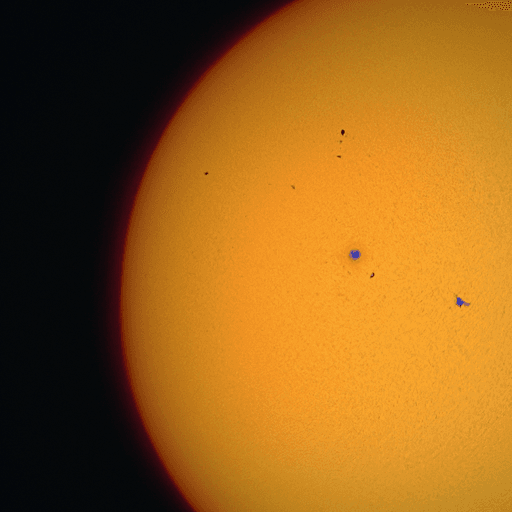
You can measure the width of the sun without a telescope. All you need are two cardboard boxes and a meter stick.
You tape aluminum foil with a tiny pinhole to one box. The other box holds a card with two parallel lines 8 mm apart. Both boxes slide onto the meter stick. Aim the pinhole at the sun and a bright image appears on the far card. Slide the second card until the image fills the gap between the lines.
The distance between the two cards plus a simple ratio gives you the sun's diameter. You then compare your result to the accepted value of 1,391,000 km.
Hypothesis
The hypothesis is that the diameter of the sun can be accurately measured from Earth.
A tiny hole forces light to travel in straight lines from an object to form an image on the back wall — which is exactly how this sun-measuring instrument works. You tape aluminum foil with a pinhole to one cardboard box, then slide both boxes onto a meter stick and aim the pinhole at the sun. A bright image appears on the card inside the far box, created by sunlight passing through that single small opening.
When sunlight passes through a tiny pinhole, it forms a real image of the sun on a surface beyond. To measure the sun's actual diameter, you tape aluminum foil with a pinhole to one cardboard box and a card with two parallel lines 8 mm apart to the other. Both boxes slide onto a meter stick. Aim the pinhole at the sun and a bright image appears on the far card. Slide the second card until the image fills the gap between the lines. That distance, combined with a simple ratio, gives you the sun's diameter — which you then compare to the accepted value of 1,391,000 km.
Method & Materials
You will construct an instrument with two boxes, two pieces of cardboard, a meter stick, a razor blade, masking tape, and a piece of aluminum foil. You will then point the instrument towards the sun and measure the distance between the two cards.
You will need two small cardboard boxes, two pieces of stiff cardboard, a meter stick, a single edged razor blade or sharp knife, masking tape, and a small piece of aluminum foil.
MEL Physics — hands-on physics experiment kits delivered monthly — real experiments, not just reading. (Affiliate link)
After measuring the distance between the two cards, you can use the formula to calculate the diameter of the sun. The results of this experiment show that the diameter of the sun can be accurately measured from Earth.
Why do this project?
This science project is unique because it allows students to measure the diameter of the sun from Earth, using a simple instrument.
Also Consider
Experiment variations to consider include measuring the diameter of the sun at different distances from Earth, or measuring the diameter of the sun at different times of the year.
Full project details
Additional information and source material for this project are available below.