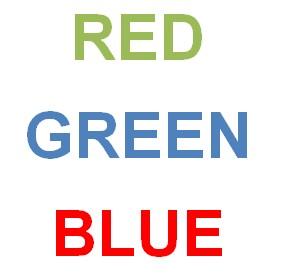
Does your brain slow down at reading colored words as you get older? You give 60 participants three tests. First, they read color names printed in black. Then they read color names printed in mismatched colors. Finally, they say the ink color instead of the word.
The participants range from age 10 to 60. Each group gets 30 seconds per test. Younger participants score higher on all three tests. The biggest gap appears on the hardest test, where participants must ignore the word and name the ink color.
Hypothesis
The hypothesis is that older test subjects perform more poorly at the Stroop test.
The interference between word reading and ink naming can be measured by comparing tasks with and without word-color conflict. You give 60 participants three tests: first reading color names printed in black, then reading color names printed in mismatched colors, and finally saying the ink color instead of the word. Participants range from age 10 to 60, each group getting 30 seconds per test. Younger participants score higher on all three, but the biggest gap appears on the hardest test — where they must ignore the word and name the ink color.
The ability to suppress one response in favor of another — and how much that ability changes with age — is what a three-part Stroop test measures. Participants first read color names printed in black, then read color names printed in mismatched colors, and finally say the ink color instead of the word. That last task is the hardest: the brain must ignore the written word entirely and focus only on the ink color. Across 60 participants ranging from age 10 to 60, each group gets 30 seconds per test. Younger participants score higher on all three tests, and the biggest gap appears on the hardest test — where the brain's filtering effort is greatest.
Method & Materials
You will divide the participants into three age groups and give them three tests. The first test will involve reading words written in black. The second test will involve reading words written in a color different from the color represented by the written word. The third test will involve announcing the color of the text out loud.
You will need 10 male and 10 female participants aged 10 to 20, 21 to 40, and 41 to 60. You will also need two cards with 50 colors randomly written in black, two cards with 50 colors randomly written where the color of the text must be different from the color represented by the written word, a stopwatch, and an assistant.
Eureka Crate — engineering & invention kits for ages 12+ — monthly projects that build real-world skills. (Affiliate link)
The results showed that the younger participants had higher average scores than the older participants in all three tests. This proves that our hypothesis was correct - older test subjects perform more poorly at the Stroop test.
Why do this project?
This science project is interesting because it explores how age affects our ability to process conflicting information. It also enables us to evaluate the reaction time taken required understand and complete the conflicting task.
Also Consider
To improve the reliability and accuracy of our results, a larger sample of participants should be used. This science project may also be repeated, this time, to test if the font size will influence the results of the Stroop effect.
Full project details
Additional information and source material for this project are available below.